
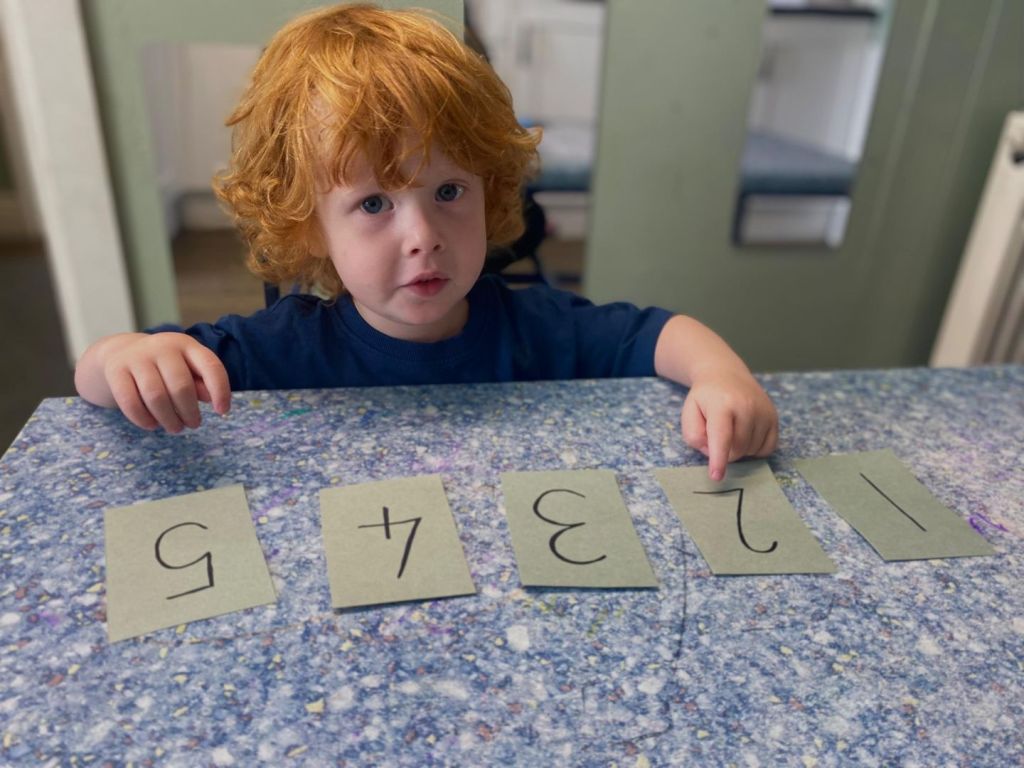

The learning environments of Sunshine aim to provide a homely and welcoming atmosphere where children feel safe to play, explore, form friendships, and learn. We work to ensure that our spaces are rich in language and communication, with lots of collaborative play, songs, and stories. The layout of our rooms is carefully planned, with opportunities for age-appropriate physical development and lots of creative play.
There is consistency in our environments, which are equipped with natural materials and inspired by the curiosity approach; this ensures smooth transitions for children as they grow and progress through the rooms. Resources and planning are sequenced to continually provide stimulation and challenge, ensuring that children make strong and continued development across the whole range of the Early Years Foundation Stage [EYFS]. The following lists are not exhaustive, but they are some of the main aspects of the EYFS that we focus on, and areas where we feel home learning can have the biggest impact.
0-2 years
Goals we are working towards:
- Beginning to put two or three words together ‘more milk’ and asking questions ‘what that?’
- Promoting interest and curiosity of other people and forming relationships.
- Building independence, particularly around feeding and getting dressed, shoes and coats on etc.
- Developing good fine and gross motor skills – run with confidence, kick a ball, jump with both feet, hold tools to make marks (pens, chalk, paintbrushes etc.)
How you can support at home:
- Narrating and labelling – ‘First, we’ll tidy all of our things away and then we’ll have a walk to the park to feed the ducks’ / ‘can you hear the train coming? Look there it is behind the trees’.
- Singing nursery rhymes
- Sharing books and stories together.
- Visiting family and friends together, looking at pictures of them and talking about who they are.
- Give your child their own spoon at mealtimes to encourage self-feeding, support and encouraging holding their own bottle or cup. Give time, opportunity, and encouragement to attempt dressing and undressing. tip* Providing clothes that are a bit too big for them makes practicing dressing and undressing a bit easier!
- Give space and opportunity for your child to develop gross motor skills, outside wherever possible. Have mark making equipment available to access together.
2-3 years
Goals we are working towards:
- Further developing language and beginning to understand verbs/action words – e.g. can identify ‘who’s jumping?’ and adjectives/describing words – ‘which dog is the biggest?’
- Forming friendships and playing alongside other children of a similar age, learning to share and take turns
- Show confidence in self-care routines, including feeding themselves, starting to dress independently and toilet training (it is important not to introduce toilet training too early, we wait for cues and prompts from children and offer lots of support and encouragement when they are ready).
- Children will hopefully begin to use numbers and start to count – they may begin to recognise some numerals, such as their age and associating it with the numeral ‘2’.
How you can support at home:
- Narrating and labelling – singing nursery rhymes – sharing stories – encouraging conversations with open-ended questions [those which can’t be answered with yes or no] e.g ‘where should we go after the park?’ – ‘I wonder how long will it take us to walk to nannas…’ etc.
- Playing turn taking games like Snap, Snakes and Ladders, dominoes etc. These also provide a great opportunity to support emerging mathematical skills and knowledge.
- Giving time for dressing and undressing, lots of praise and encouragement and modelling where needed.
- Talk about numbers in the environment, including house numbers and signs. Begin to introduce mathematical language to describe things (shape, size, weight, position).
3-4 years
Goals we are working towards:
- Developing strong and confident speaking and listening skills. For children to maintain attention during stories and group activities. Developing recall skills, can give details from stories they’ve heard or talk about their own experiences.
- Playing and interacting well with friends, sharing, taking turns, and showing kindness.
- Developing good independence and self-care; showing confidence in putting on coats, hats and shoes as well as using the toilet and washing hands.
- Showing an awareness of letters and print; noticing familiar letters (such as the first letter of their name) and working towards writing letters accurately and clearly.
- Showing a good understanding of numbers and mathematical ideas, recognising numerals 1-10 and being confident in using the language of size, shape, weight, and positional language (on top, next to, below etc.)
How you can support at home:
- Speak with your child about their day and encourage them to talk wherever possible. Make time to share stories and to discuss them afterwards, engage in imaginative play and use this to extend talking and introducing new vocabulary. Here are our core texts that we share and explore through our curriculum at Sunshine, which you might find useful as a starting point.
- Encourage your child to get dressed independently and make time for this wherever you can. Support and encourage them with other self-care tasks including washing their hands, brushing their teeth (but always brush them yourself afterwards) and using the toilet without support.
- It is important that children are given opportunities to mark make with different tools (pens, paint, chalk, paintbrushes etc.), to use scissors with supervision; and to play with malleable materials (like play dough) to develop the muscles used when writing.
- To support mathematical understanding, you can point out shapes and numerals in the environment (house numbers, bus numbers, details on signs etc.) and talk about differences between things using the language of size, weight, shape etc.
Sunshine Day Nursery
4 Clifford Street, Redcar. TS10 1RW
sunshinenurseryredcar@gmail.com
01642 486803
 Sunshine Day Nursery